 THE GREAT
REINVENTION
THE GREATThe Great Reinvention is a visionary policy movement that reclaims wasted government resources and reinvests them in the American people — through automation, fair taxation, and radical efficiency. This is a blueprint for justice, dignity, and transformation, rooted in values and powered by innovation. The future is ours to build — together.
Powered by dignity. Funded by efficiency. Rooted in purpose.
For decades, we have watched infrastructure crumble and inequality widen. Good jobs vanish as industries change, while our roads, bridges, and railways rust with age. Stagnation means accepting that decline – a future where opportunity is scarce, division grows, and we fear the very technologies that could help us. But another story is possible. In labs and startups, on farms and in factories, Americans are innovating with AI, clean energy, and new ideas. We have more tools than ever to solve our toughest problems – from climate change to healthcare – if only we choose to harness them. Reinvention means embracing those tools and our own ingenuity to build a thriving nation for all.
America has reached such turning points before. In times of depression, war, or social crisis, we did not surrender to despair – we invented the New Deal, we sent a man to the moon, we built the interstate highways. Each time, we chose reinvention over fear. Today, the challenges are new but the choice is the same. Will we allow stagnation to dim the American Dream, or will we transform our nation with courage and vision? This manifesto chooses the path of hope and transformation. It is a vision of an America revitalized – one that generates its own prosperity and invests boldly in its people and planet.
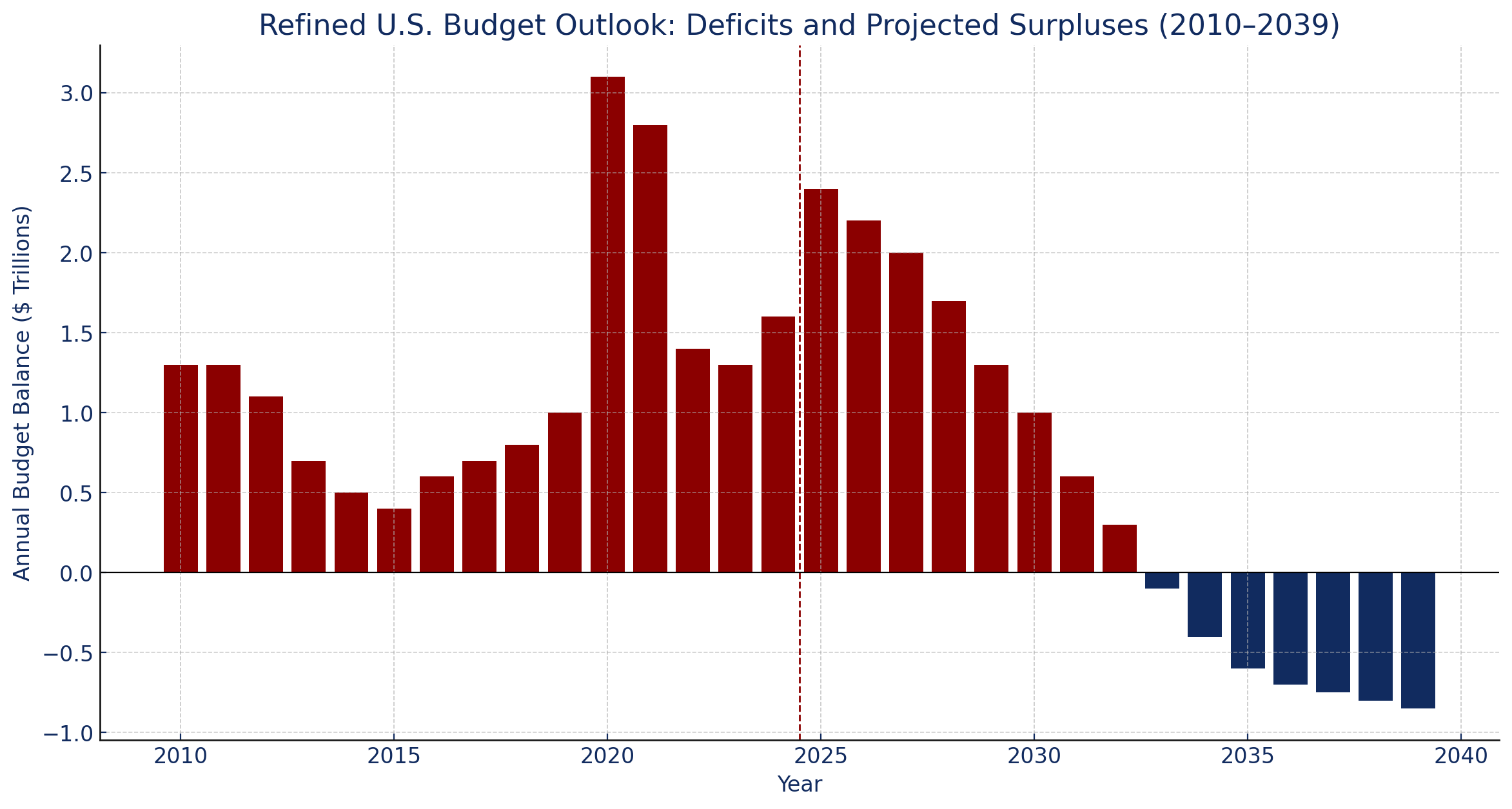
To turn this vision into reality, we must be as pragmatic as we are ambitious. By combining technological innovation, efficient government, and fair economic policy, we can unlock over $2.2 trillion every year in savings and new revenue. This is not a fantasy number; it’s money already in our system, currently misallocated or wasted, that we will redirect toward the public good.
Every dollar of reinvestment is paid for by eliminating waste, modernizing systems, and asking those at the very top to pay what they owe.
Modernize Social Security and Medicare with fairness: gradually raise the retirement age for younger generations, cap benefits for ultra-wealthy retirees, and expand drug pricing reforms — protecting the safety net while reducing its unsustainable growth.
Learn More →Introduce a carbon dividend, financial transaction tax, and end loopholes for carried interest, offshore income, and unrealized capital gains. Close the $540B+ annual tax gap with advanced enforcement and tech.
Learn More →By transitioning to AI-driven command systems, autonomous drones, and robotic logistics, we reduce personnel costs, cut redundant spending, and maintain national defense without the massive overhead of traditional armed forces.
Learn More →By closing loopholes for corporations and billionaires and applying a fair share tax on ultra-wealth, we generate hundreds of billions in new revenue — without raising taxes on the working class.
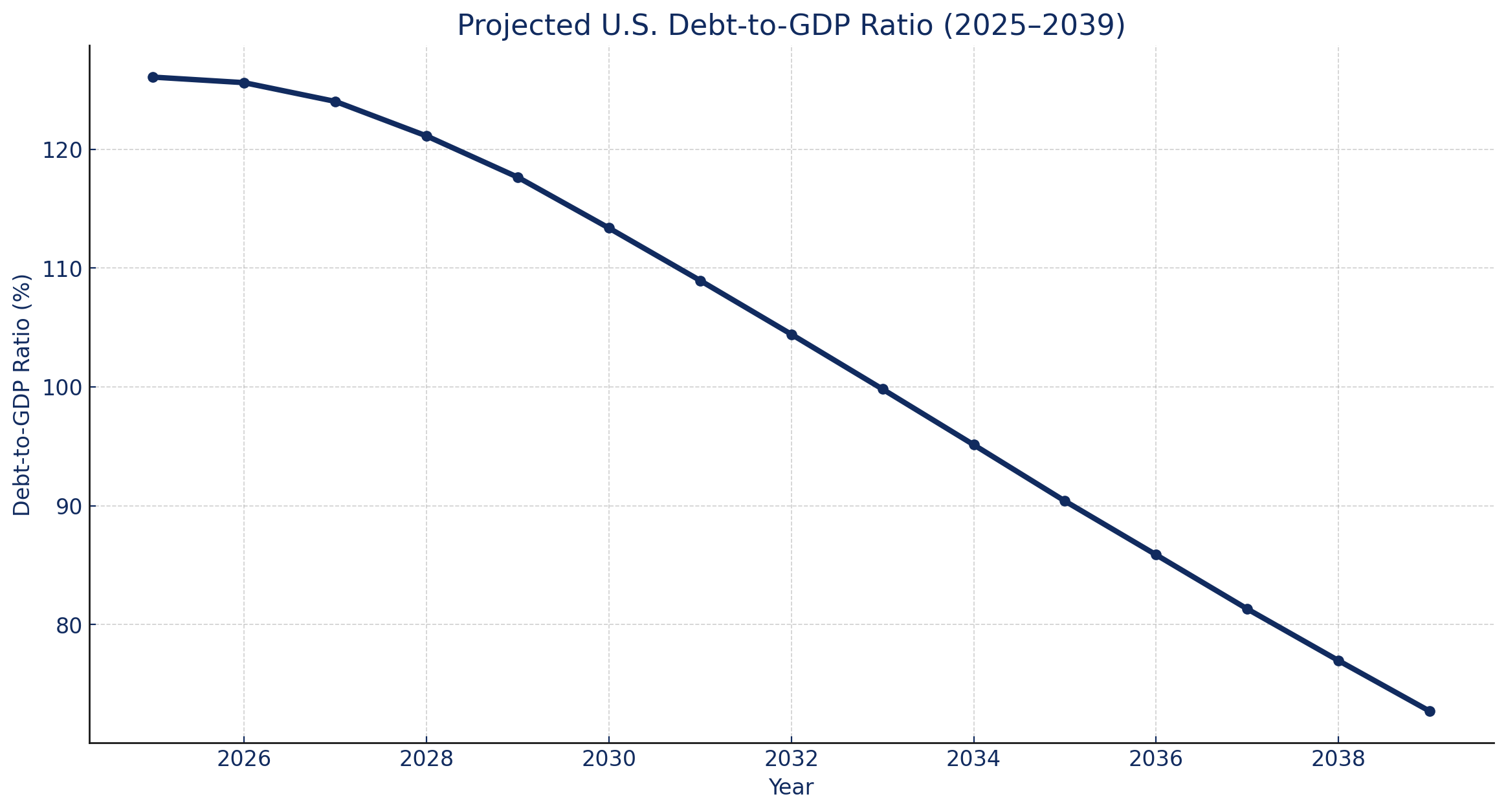
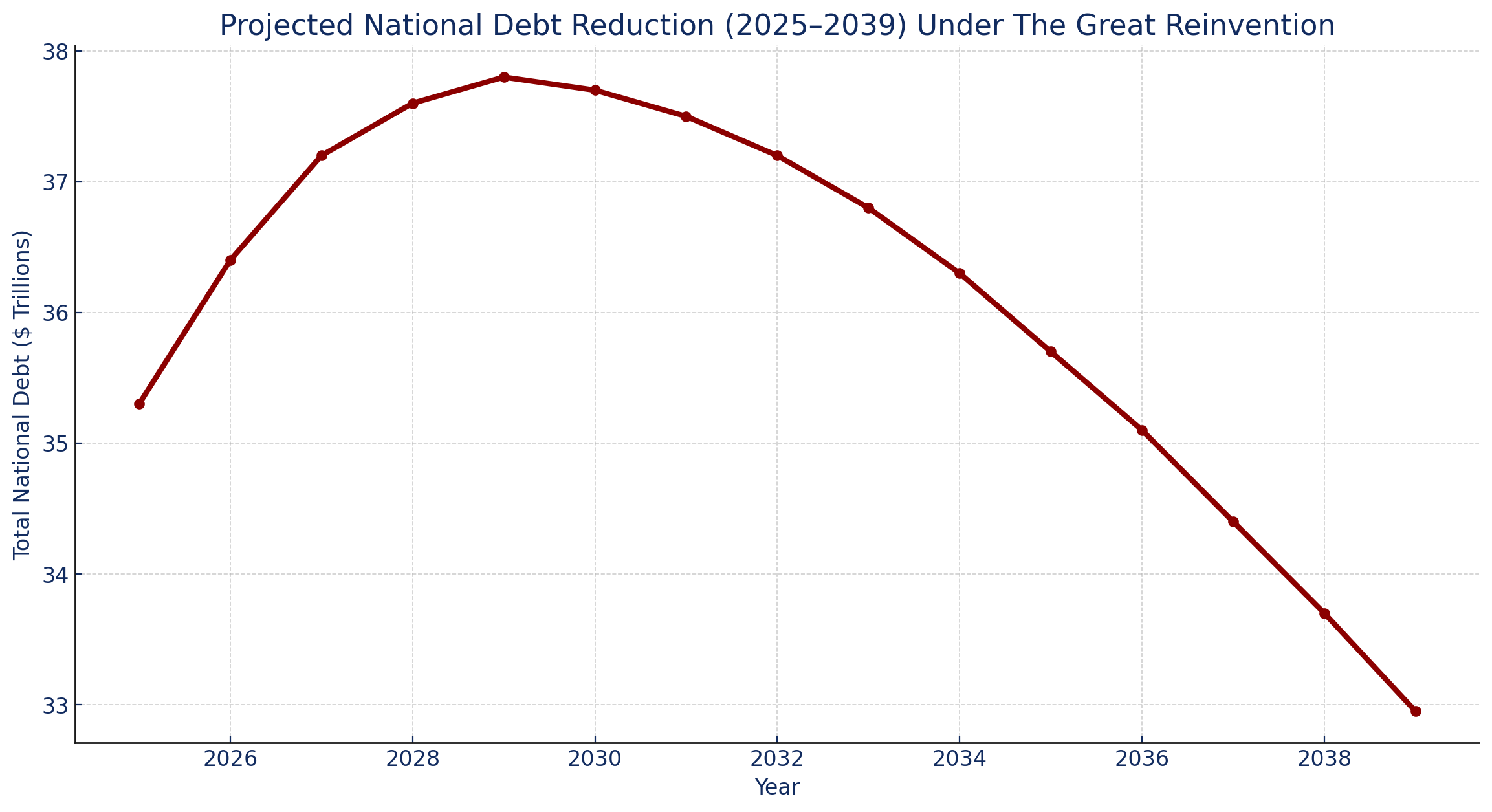
Learn More →Use surplus funds to aggressively reduce debt principal — compounding interest savings annually and structurally reducing the federal burden over decades.
Learn More →Focusing on early detection, full-body diagnostics, and lifestyle-based treatment dramatically reduces the cost of treating advanced disease. A system that prevents illness saves lives — and billions.
Learn More →Beyond automation, cut redundant weapons programs, reduce contractor overreliance, and close unnecessary overseas bases — building a leaner, smarter force.
Learn More →Replacing outdated, paper-based bureaucracy with intelligent automation in federal agencies means faster services, lower costs, and far less waste. AI-powered systems can manage benefits, taxes, and public records with speed and transparency.
Learn More →AI-assisted audits of every federal department will uncover waste, corruption, and duplication. We build a culture of efficiency by tracking every dollar and holding every agency accountable.
Learn More →Eliminate wasteful corporate welfare and outdated tax breaks, especially for fossil fuel and agribusiness giants. These savings can be redirected toward working families, small businesses, or national debt reduction.
Learn More →Streamline federal and local education bureaucracies, consolidate duplicative programs, and reinvest the savings in classrooms, teacher pay, and student support.
Learn More →Reduce incarceration for low-level offenses, expand alternatives like drug courts, and reinvest the savings into reentry, addiction treatment, and violence prevention.
Learn More →Shrink the government’s physical footprint by selling or repurposing underused buildings and offices. These efficiency measures save operating costs and reduce the $370B deferred maintenance backlog.
Learn More →Freed from stagnation’s constraints and armed with over $1T in annual fuel for progress, we will embark on a once-in-a-century renewal. This is a long-term nation-building effort on par with building the interstate highways or winning the Space Race – and its impact will be felt within our lifetimes. Year by year, these investments will blossom: new industries will emerge, communities will thrive, and ordinary Americans will see tangible improvements in their daily lives.
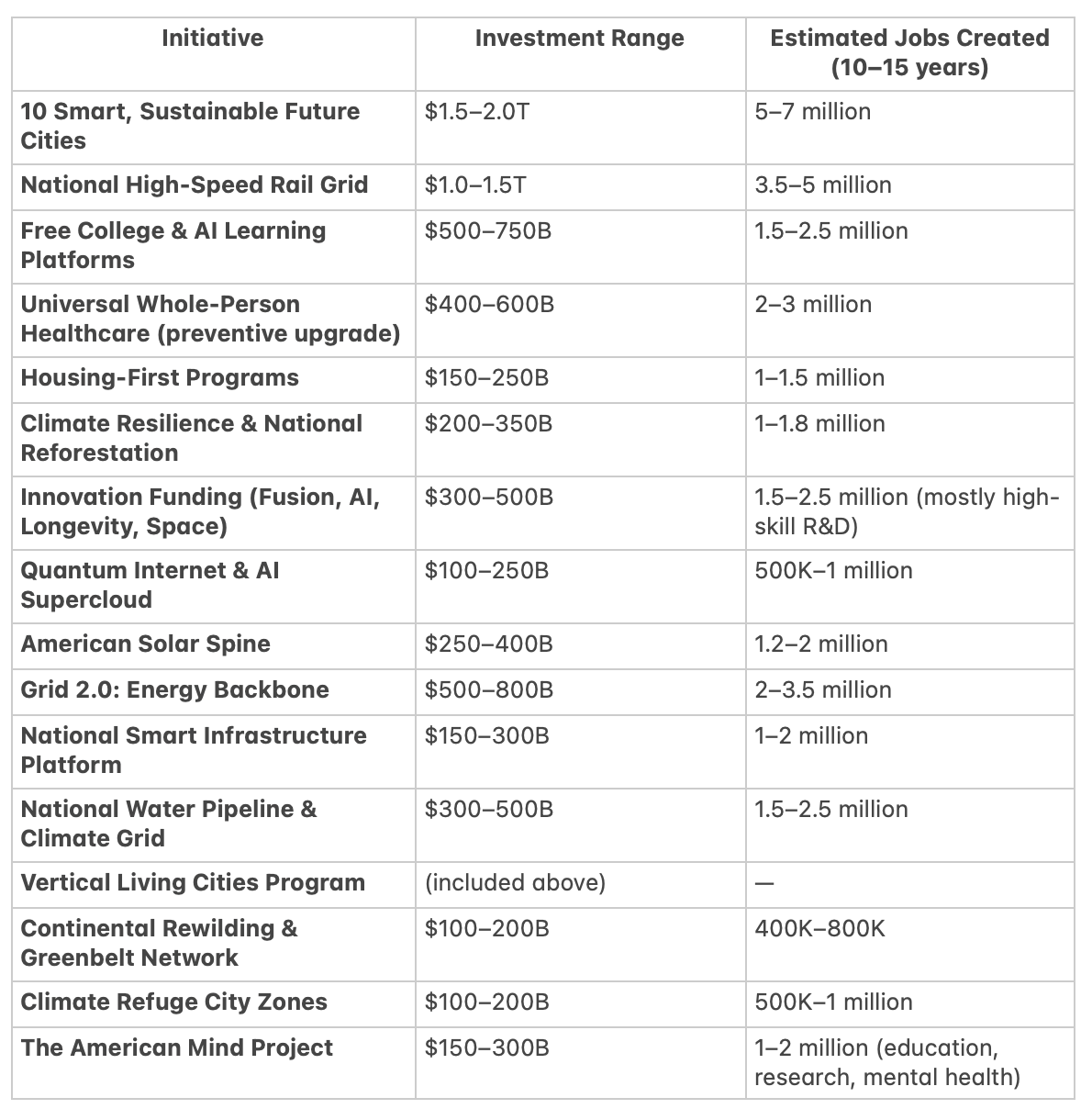
Purpose-built cities powered by clean energy, advanced transit, and vertical farming — designed for equity, walkability, and community. These hubs will model what life in a human-first, car-free future can look like.
Learn More →Connect every major metro with clean, fast, high-speed trains. Reduce emissions, boost regional economies, and cut travel times coast-to-coast.
Learn More →Make higher education tuition-free and lifelong learning universally accessible through advanced AI tutors, immersive online platforms, and apprenticeships.
Learn More →Shift from reactive medicine to preventive, integrative care — including full-body scans, mental health, lifestyle support, and early diagnosis.
Learn More →Launch the largest reforestation project in history, restore ecosystems, and prepare cities for rising heat, floods, and storms with green infrastructure.
Learn More →Invest in frontier technologies that will define the 21st century: fusion power, AI for public good, life-extending medicine, and exploration beyond Earth.
Learn More →Launch a national command system for cybersecurity, quantum communication, and AI infrastructure — connecting the country.
Learn More →A national high-voltage transmission backbone linking sun- and wind-rich regions to major demand centers — delivering clean, cheap power coast to coast and ending the bottlenecks that strand renewable energy today.
Learn More →Fully rebuild the U.S. electrical grid with underground, AI-optimized, stormproof infrastructure that’s ready for the renewable era.
Learn More →Embed sensors in every road, bridge, and rail to create an AI-powered network that ensures safety and seamless navigation for autonomous vehicles.
Learn More →Link flood-prone regions to drought-stricken ones through a smart national water network — with desalination, reservoirs, and dynamic controls.
Learn More →Develop high-density skyscraper communities with built-in housing, transit, parks, and food — a new model for compact, climate-positive urban life.
Learn More →Restore wild lands and regenerative farms across all 50 states, creating a living green infrastructure as iconic as the National Park system.
Learn More →Build purpose-designed, tech-enabled urban centers to welcome and house those displaced by climate change — while revitalizing depopulated regions.
Learn More →Create a national research network for AI, biotech, and human flourishing — linked by high-speed rail, fellowships, and bold public-private labs.
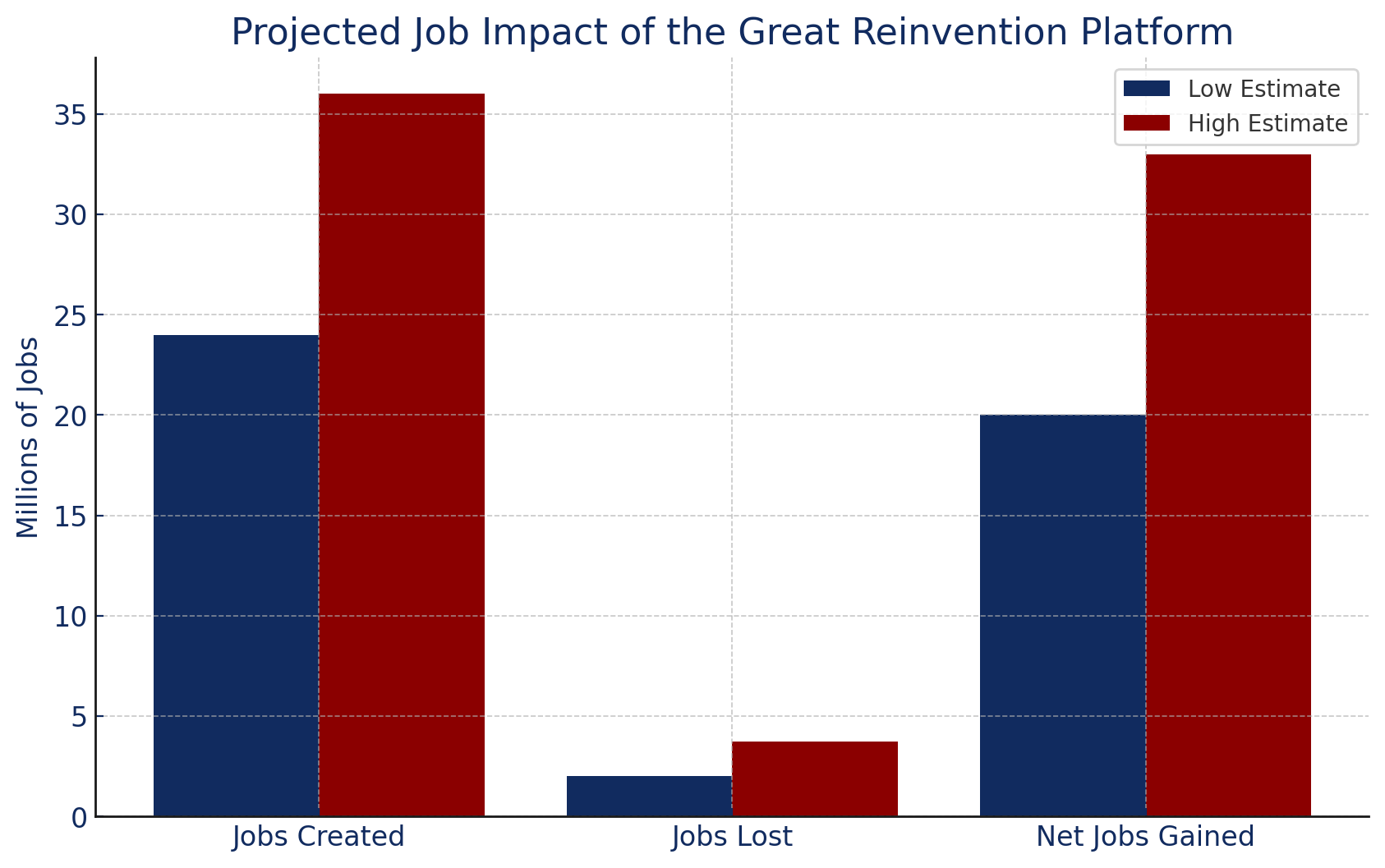
Learn More →Massively net-positive employment. Even after factoring in cuts and automation, our plan still generates 20–33 million net new jobs. That’s comparable to adding the equivalent of every job in California and Florida combined.
High job diversity. It’s not just construction and green tech — we’re creating roles in healthcare (preventive care, wellness coaching), education (teachers, AI curriculum designers), technology (quantum, AI, software), infrastructure (energy, water, smart transit), research and science (fusion, climate, medicine), forestry and rewilding (conservation, reforestation), and mental health and caregiving (the Mind Project).
Geographic equity. Jobs would be dispersed across rural, suburban, and urban America, not just clustered in tech hubs or coastal cities — helping reduce regional inequality and political polarization.
Replaces old jobs with better ones. While some outdated bureaucratic or defense contractor jobs are phased out, they’re replaced with purpose-driven work tied to climate resilience, community wellness, and innovation.
Future-proof. We’re building industries of the future — not reviving old ones. That attracts younger workers, promotes long-term productivity, and increases America’s global competitiveness.
24–36 million new jobs, for everyone.
We’re rewriting the rules — to make America more fair, more free, and built for the future.
We’re restoring real competition by breaking up monopolies that choke our economy — from Big Tech and Big Pharma to food giants and media empires. When just a handful of corporations control your choices, your data, your food, and your future — that’s not capitalism. It’s corporate feudalism. We’re ending it.
Learn More →America’s government was built for the 20th century. We’re streamlining 400+ outdated agencies into six tech-powered departments designed for speed, efficiency, and impact. With AI automation, digital permits, and transparent systems, we’ll replace red tape with real results — saving over $1 trillion annually.
Learn More →We’re launching a new Department of Digital Infrastructure and Security to protect the nation in the digital age. This agency will oversee cybersecurity, AI safety, quantum internet, and core web protocols — replacing patchwork oversight with unified command. The internet is our new infrastructure. It’s time we treated it that way.
Learn More →We’re shifting from a sick-care system to a wellness-first model. That means investing in mental health, nutrition, early intervention, community care, and clean environments. It’s time to stop reacting to illness and start building health from the ground up — saving lives and billions along the way.
Learn More →We’re replacing the chaos with clarity. A 21st-century immigration system means fast, secure digital processing, clear legal pathways, and modern humanitarian standards.
Learn More →Our movement’s vision is built on a foundation of concrete policies that reinforce each other. From harnessing technology for good to healing our planet, these policy pillars cover all aspects of a thriving, fair society — ensuring our bold investments have the support of smart governance and shared values at every level.