
Cost-Benefit Analysis of a Fully Automated U.S. Military
Current Costs of U.S. Military (Personnel, Training, Healthcare, Logistics)
The United States spends a vast sum on its military each year – $820 billion in FY2023 – accounting for about 13% of federal outlays. The Department of Defense (DoD) received about $776 billion of that (the rest went to defense-related agencies like the Dept. of Energy for nuclear programs). These funds cover everything from troops and training to weapons procurement and healthcare. Key cost components include:
-
Personnel: Salaries, housing allowances, bonuses, and pensions for service members make up a significant share. In 2023, military personnel costs were $184 billion (about 24% of the defense budget) This includes pay for ~1.4 million active-duty troops, ~0.8 million reservists, and ~0.8 million civilian DoD employees. On average, each active-duty member costs the Pentagon around $140,000 per year in pay and benefits. When factoring in family benefits and the Defense Health Program, total personnel-related expenses exceed $200 billion annually. These costs have risen over time due to generous benefits, healthcare, and above-inflation pay raises.
-
Operation & Maintenance (O&M): The largest portion of the budget – $318 billion in 2023 – goes to O&M. O&M covers the “readiness” costs of running the force: training exercises and education, fuel and supplies, depot maintenance of equipment, repairs, and day-to-day logistics. Notably, training personnel is a major expense. It costs $50,000–$100,000 to train a single new soldier (basic training and initial specialty training) and then at least $100,000 per year thereafter to sustain that soldier’s training, health care, pay, and housing. Multiply this by thousands of recruits annually and ongoing skill training for all troops, and training expenditures run into the tens of billions. Logistics to support deployments also balloon costs – for example, at the height of the Afghanistan war, each U.S. soldier in-theater cost about $850,000 per yearwhen factoring in combat pay, transportation, and supply lines. By contrast, some ground robots (e.g. the TALON bomb-disposal robot) cost about $230,000 upfront illustrating how expensive human deployments can be.
-
Healthcare: Military healthcare for active-duty personnel, their families, and retirees is a significant cost. DoD’s health program (separate from the VA) is mostly funded under O&M, about $50 billion annually. This covers the Tricare health system, on-base medical facilities, and combat casualty care. Even with this, the Department of Veterans Affairs (VA) spends over $300 billion per year (FY2023) on veterans’ benefits and healthcare for those who served in past wars – a downstream cost of having a large human force. A fully automated military would, in theory, drastically reduce the creation of new veterans requiring lifelong care.
-
Procurement and R&D: Equipping and upgrading the force is another major cost, though not directly related to personnel. In 2023, DoD spent $142 billion on procurement (buying weapons, vehicles, etc.) and $122 billion on R&D (developing new technology). Many of these programs (new aircraft, ships, etc.) are driven by requirements for human operators (e.g. pilot safety systems). A shift to unmanned systems could change the nature of these investments. For instance, unmanned aircraft can be cheaper per unit and require less life-support equipment. The Air Force’s RQ-4 Global Hawk drone, for example, has about 17% lower life-cycle cost per flight-hour than a manned P-8 patrol aircraft, largely due to savings in operating costs. However, some advanced drones still have hefty price tags, and high-tech robotics development is expensive upfront.
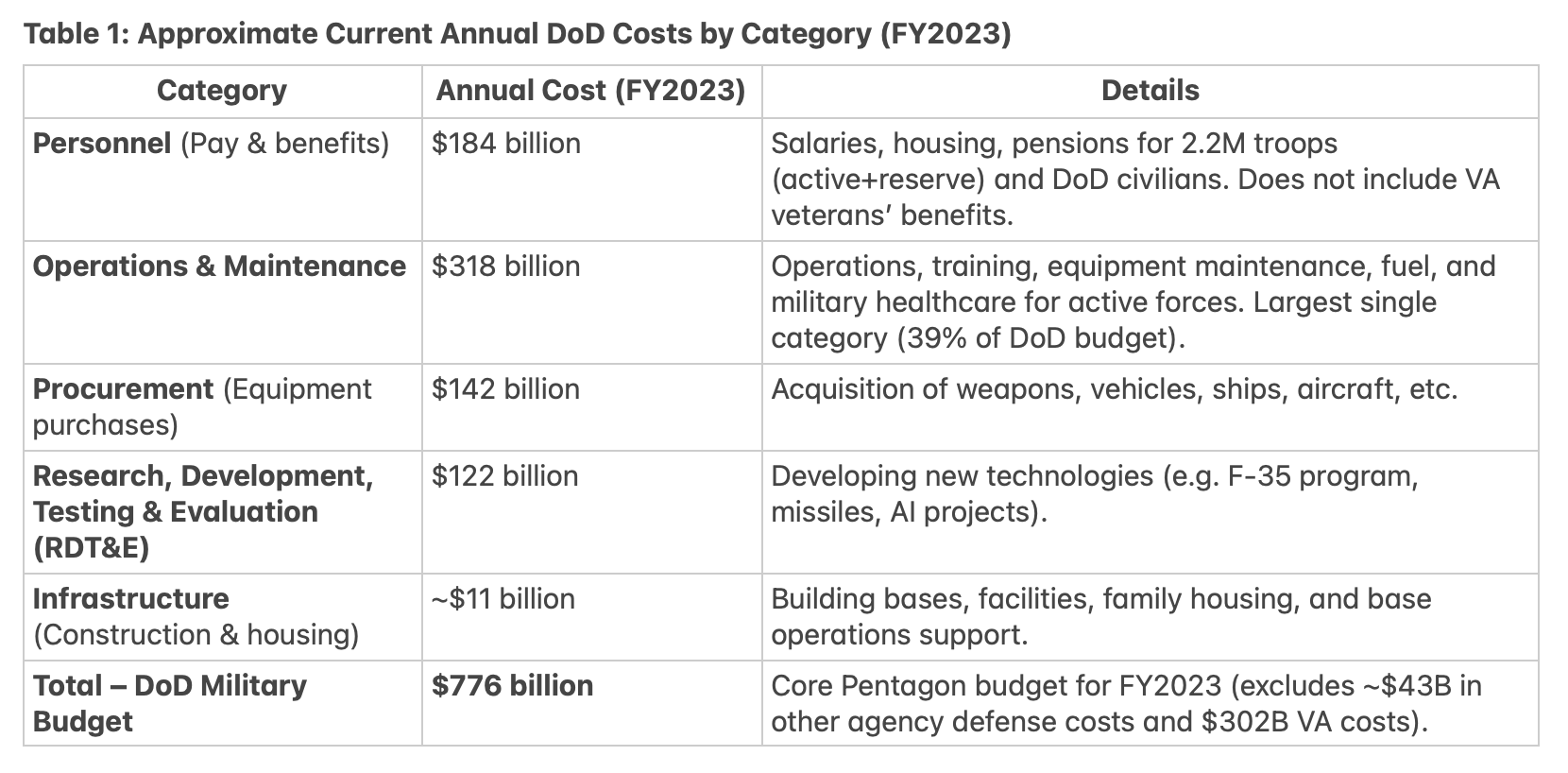
As shown, maintaining a human-centric force is extremely costly, especially for personnel and the associated training, support, and healthcare. These areas are prime targets for savings if automation could replace human roles.
Transition Costs to a Fully Automated Force
Moving from today’s manpower-intensive military to a fully automated force would require enormous upfront investments. This transition would likely unfold over a decade or more, involving the development, procurement, and integration of advanced AI systems and robotic platforms across all branches (Army, Navy, Air Force, Marines, Space Force). Major transition cost elements include:
-
AI Systems Development: Creating artificial intelligence capable of performing command, control, and decision-making roles now done by officers is a monumental task. This means funding cutting-edge R&D in machine learning, autonomous decision algorithms, and war-gaming simulators. The Pentagon has begun investing in these areas (for example, the Joint All-Domain Command and Control concept to network AI across forces). However, achieving a reliable AI “brain” for a fully autonomous military might resemble an Apollo Program-scale effort. One can envision tens of billions of dollars spent on developing advanced battle management AIs, training them with vast datasets (including decades of tactical data), and testing them in simulations and limited field trials. Robust testing and validation will be critical to ensure these AI decision-makers are safe and effective before entrusting them with real weapons.
-
Autonomous Platforms (Drones, Unmanned Vehicles & Vessels): The military would need to procure thousands of autonomous systems to replace human-operated tanks, artillery, ships, and aircraft. This includes combat drones of all sizes, unmanned fighter jets, autonomous tanks and armored vehicles, robotic submarines and surface ships, and even humanoid or ground robots to replace infantry roles. While individual unmanned systems can be cheaper than manned ones (e.g., a Reaper drone ~$16M vs. an F-35 ~$80M), scaling up to cover the entire force is extremely costly. The Army has explored replacing a portion of brigades with robots – e.g. cutting 25% of troops by using support robots – but full replacement means far more units. We can estimate on the order of $1–2 trillion over the transition period for procurement of autonomous platforms. This rough figure comes from considering that current replacement value of major equipment (aircraft, ships, vehicles) in the U.S. inventory is trillions of dollars; unmanned replacements might be somewhat cheaper per unit, but the military might also choose to field a larger number of smaller, cheaper systems (e.g., swarms of drones) to increase coverage. Each category of platform brings its own costs: for example, equipping an entire Air Force wing with unmanned combat drones or loyal wingmen could cost many billions, and the Navy’s plan for unmanned ships suggests significant investment as well.
-
Robotic Infrastructure and Maintenance Automation: A fully automated force isn’t just the combat units – the logistics and maintenance tail must also be automated. This means investing in smart maintenance facilities where robots and predictive algorithms handle repairs and refueling. It also means autonomous cargo aircraft and trucks for supply delivery, robotic munitions loaders, and even automated base security and surveillance systems. Upgrading bases to support a robot army (with charging stations for electric drones, specialized repair bays, etc.) would require major military construction projects. Initial outlays for this infrastructure could be in the hundreds of billions, spread across domestic bases, overseas installations, and naval shipyards refitted for drone fleets. The benefit is that, once in place, these smart facilities could operate with minimal human staffing.
-
Cybersecurity and Resilient Networks: Perhaps the most crucial (and often underestimated) cost is securing the entire system. A fully automated military would rely on networks linking sensors, AI “command brains,” and shooters (drones, missiles, etc.) together at machine-speed. These networks must be highly secure, jam-resistant, and hardened against cyberattack, since a hacker who infiltrates or corrupts the system could potentially hijack U.S. military assets. Developing secure communications (potentially via quantum encryption, dedicated military satellites, etc.), robust anti-jamming technology, and active cyber-defense units will be expensive. Additionally, every autonomous platform and AI needs protection from being spoofed or hacked. (Notably, Iran allegedly commandeered a U.S. drone in 2011 via cyber intrusion, showing the risk.) The Pentagon would need to pour resources into cybersecurity R&D and redundant fail-safes. Estimates are difficult, but this could easily be tens of billions of dollars in network infrastructure, plus ongoing cyber-defense operations during and after the transition.
-
Program Management and Training for Transition: During the shift, there would be a period where humans and machines work side-by-side. Funds would be needed to retrain human personnel for new roles – for example, programming or supervising autonomous systems – and to manage the phased decommissioning of human units. There may also be costs for severance or veterans benefits for personnel who are cut as automation comes online. While harder to quantify, these transitional human resource costs could be significant in the short term (e.g., incentives for early retirement of thousands of service members, job placement programs for displaced defense workers, etc.). Additionally, comprehensive field exercises would be necessary to integrate AI and robotics into tactics – effectively “training” the AI and validating it – which would incur testing and evaluation costs.
In summary, the one-time transition costs could easily reach into the trillions of dollars spread over a decade or more. For perspective, even maintaining a mixed human/machine force has huge costs (the F-35 fighter program is projected at ~$1.7 trillion over its life cycle); a wholesale transformation of the U.S. military would dwarf individual programs. This upfront investment, however, is made with the expectation that post-transition annual savings and improved effectiveness would eventually offset the costs.
Post-Transition Operational Costs of a Fully Automated Force
Once the U.S. military has been transformed into a primarily AI-driven, robotic force, the ongoing annual operating costs would look very different from today’s. Most notably, personnel costs would plummet. Instead of millions of service members on payroll, only a small cadre of top commanders and technical specialists would remain in service. There would be minimal expenditure on salaries, housing, and human healthcare – perhaps only a few billion dollars to support a few thousand human overseers (and whatever support staff or technicians are still needed). The vast network of bases for training and housing troops could be consolidated, with many facilities closed or repurposed, further reducing overhead.
However, a fully automated force would incur its own set of recurring costs:
-
Maintenance of Robots and Autonomous Systems: Just like tanks, jets, and ships today require maintenance, so too will drones and robots. There will be ongoing costs for spare parts, software updates, battery replacements or fuel, and repairs of wear-and-tear. The good news is that many routine maintenance tasks might be handled by other robots or predictive AI systems, potentially increasing efficiency. Robots do not require pay raises, healthcare, or retirement, and they can be taken offline for maintenance without the complex personnel logistics that humans need. The Army has noted that while a robot might cost about the same to acquire as a soldier to recruit and train (~$50–100k), its maintenance and storage are “much less” costly than a human’s ongoing needs. Over time, robotic systems could also be designed for easier upgrades (modular components swapped by machines). Net effect: equipment upkeep remains a major budget item, but likely at lower cost than a human-equivalent force.
-
AI Software Maintenance and Upgrades: The “brain” of an automated military – its AI algorithms and control systems – will require continuous updates. Just as software companies issue updates, the Pentagon would need to invest in continuous development of AI to fix bugs, patch security vulnerabilities, and improve performance. This is analogous to current R&D but may become a more routine, ongoing cost (closer to how one maintains big IT systems). The cost of software engineers, data scientists, and AI training data curation will be a permanent fixture. Fortunately, software can often be duplicated at low marginal cost; one AI upgrade can be rolled out across the entire force. This suggests economies of scale – maintaining 1000 autonomous drones might not be vastly more expensive in software terms than maintaining 100, since the same update is applied fleet-wide. Nonetheless, cyber defense will also be a perpetual effort (monitoring for hacking attempts, improving encryption, etc., as adversaries evolve).
-
Energy and Fuel: Human armies spend significant resources on food, troop transport, and other human necessities. A robot army would instead have energy needs – electricity for battery-powered systems, fuel for jet drones or unmanned vehicles, etc. This could actually be a substantial cost; for instance, high-performance drones still consume jet fuel, and charging thousands of electric vehicles draws on electricity (which might come from fuel-burning generators in deployed settings). We can expect fuel and energy logistics to remain a cost, though potentially optimized. Automated convoys might deliver fuel more efficiently, and if renewable or nuclear energy is leveraged for bases or ships, operational energy costs might stabilize. It’s hard to say if energy costs would be lower or higher than today’s mixed fuel/food supply chain, but the elimination of needs like medical evacuation, water, and food convoys could simplify logistics.
-
Replacement and Procurement Cycles: Even after the transition, the military will need to procure new or replacement hardware regularly. Unmanned systems, especially smaller drones, may have shorter lifespans or higher attrition in conflicts (UAVs have been lost at higher rates than manned aircraft in practice). This means a steady production of units to replace losses or to upgrade to new models. However, because these systems might be simpler or cheaper, the procurement budget could be more predictable and potentially lower. For example, instead of $100 million next-generation fighter jets, the Air Force might buy swarms of $5 million expendable drones. Overall procurement spending might decline, but it would not disappear – it would shift to different platforms. Notably, life-cycle analyses suggest unmanned aircraft have lower recurring costs per hour (due to no pilot and simpler design), but their advantage in total life-cycle cost can be narrowed if they are replaced more often. This implies careful cost management will be needed to realize savings; the military would balance using cheaper “attritable” systems against the need to frequently replace them.
Considering these factors, we can sketch an approximate post-automation budget. Personnel and healthcare costs shrink dramatically. Operations and maintenance remains the largest piece but might be lower than today due to efficiencies (no large-scale troop rotations, fewer training exercises since AI “learns” largely via simulations, etc.). Procurement and R&D might stabilize at a lower level focused on tech refresh rather than major leaps required by human warfighter improvements. Table 2 provides a rough comparison:
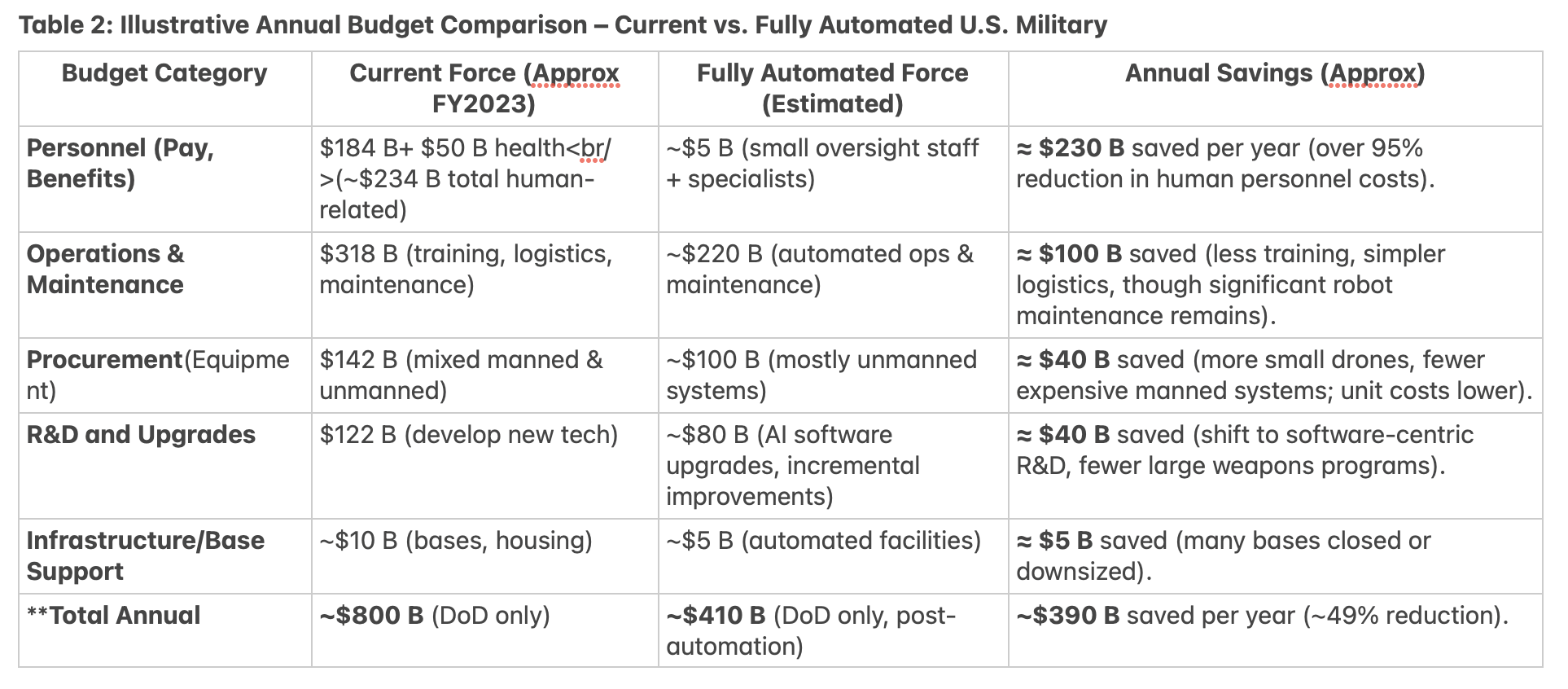
Notes: The above automated force figures are rough estimates for a steady-state future where most expensive human-related costs are eliminated. They assume efficiencies from scale and technology. Actual savings would depend on doctrine (e.g. how many robotic systems are fielded and maintained) and ongoing threat levels. Nonetheless, it suggests on the order of hundreds of billions of dollars saved each year once full automation is achieved. Over a decade, this could cumulate to $2–3+ trillion in savings, potentially offsetting the heavy upfront transition investment.
It’s important to stress that these savings would not materialize immediately – they’d come after the significant spending surge to develop and deploy the automated forces. In the first years of transition, the budget might actually grow (due to overlap of old and new systems). But once legacy systems and personnel drawdowns are complete, the defense budget could shrink substantially relative to today’s level. In essence, the government would trade high fixed costs in the short term for much lower variable costs in the long term. From a pure cost perspective, automation offers significant efficiency gains.
Risks and Downsides of a Fully Automated Military
While the cost savings and technological allure of a fully autonomous military are compelling, there are profound risks and downsides to such a transformation. These include strategic uncertainties, ethical and legal dilemmas, political and diplomatic ramifications, and socioeconomic impacts on the labor force. Below is a summary of key concerns:
-
Strategic and Security Risks: Reliance on AI and robotics introduces new vulnerabilities. Cybersecurity is a paramount concern – if an enemy hacks or tricks our autonomous systems, they could hijack weapons or render the force ineffective. This is not theoretical: Iran’s military claimed it commandeered a sophisticated U.S. drone via cyber intrusion in 2011, highlighting how unmanned assets can be captured or spoofed. A fully automated military could become an attractive target for enemy cyberattacks, electronic jamming, or manipulation of AI algorithms. Additionally, the unpredictability of autonomous systems in complex environments raises concern. AI-driven weapons might react in unforeseeable ways to novel situations, potentially leading to accidental engagements. A RAND study warned that widespread military AI could lead to “inadvertent escalation and crisis instability” – conflicts could spin out of control faster than human decision-makers can respond. Removing humans from the loop entirely might sacrifice the judgment and intuition that have prevented catastrophic mistakes in past crises. Strategically, there’s also the risk of an AI arms race: adversaries will likely build their own military AIs and drones, and competition in autonomy could become a new dimension of warfare.
-
Ethical and Legal Concerns: Turning war over to machines raises deep ethical questions. Autonomous weapon systems, often dubbed “killer robots,” challenge the principle of meaningful human control over life-and-death decisions. Can an AI sufficiently discriminate between combatants and civilians? If a drone makes a lethal mistake, who is accountable for a war crime – the machine, the programmer, the commander? International humanitarian law requires a responsible human party for any use of lethal force, which becomes murky with full automation. There is widespread fear that AI might not reliably adhere to the laws of war, especially concerning proportionality and civilian protection. Bias in AI algorithms could also lead to targets being chosen based on faulty or prejudiced data, raising moral issues. Partly due to these concerns, many nations and advocacy groups are pushing for a ban or regulation on fully autonomous weapons. The UN has seen reports of autonomous weapons deployed (e.g. in Libya) and experts are calling for new laws “urgently” to govern them. The United States would face pressure to ensure any AI-driven military use still has appropriate human oversight or failsafes, to stay within ethical bounds and international norms.
-
Political and Diplomatic Downsides: A move to a robotic military would have significant political implications. Domestically, policymakers might resist reducing human forces, both out of concern for jobs (as discussed below) and fear of unproven technology controlling national security. There could be public apprehension or backlash against delegating war to machines, especially if incidents occur (e.g., an autonomous system mistakes a target and causes civilian casualties). Internationally, U.S. allies might be uneasy about coordinating with an all-AI force – interoperability and trust could suffer if allies insist on human-in-the-loop for joint operations. It might also provoke adversaries: for instance, China and Russia might accelerate their own automation programs in response, destabilizing arms control efforts. Diplomatically, the U.S. embracing full military automation could undermine global non-proliferation initiatives for autonomous weapons. If other nations or non-state actors obtain similar tech, the threshold for conflict could drop; leaders might be more willing to engage in warfare if their own human soldiers are not at risk. This lower barrier to war is a serious concern – casualties (on one’s own side) historically serve as a check on military adventurism, but robots remove that human cost, potentially making military force a more readily used tool. There’s a danger of a global environment where many powers have “push-button” warfare capability, increasing the risk of skirmishes or escalation without the sobering risk to human life for decision-makers.
-
Labor Force and Economic Impact: The U.S. military is not just a fighting force; it’s also one of the nation’s largest employers and a pathway to middle-class livelihoods for many Americans. Roughly 1.4 million active personnel, 800,000 reservists, and an even larger number of defense contractors and civilian workers draw their income from defense. A fully automated military would render the vast majority of these jobs obsolete. The transition would mean massive layoffs or redeployments – everyone from infantry soldiers to mechanics, pilots, base support staff, and defense industry workers building traditional crewed platforms could be affected. The social and economic ripple effects would be significant. Communities around military bases (which rely on service members’ spending) could suffer if bases close. Defense contractors would need to shift to robotics and AI products, potentially needing fewer workers (since software-centric products might not require as large a manufacturing workforce as building ships or planes). Politically, this job loss makes full automation contentious – Congress has often protected military programs in the past to save jobs in their districts. Additionally, the military has intangible societal roles: it provides training, education, and discipline to young volunteers, and is a route to college funding (GI Bill) and career skills for many. Eliminating most human service members could close off opportunities for segments of the population who benefit from military service. Managing this labor transition would require careful planning – perhaps large-scale retraining programs to shift former soldiers into tech and robot maintenance roles. But realistically, the human cost in terms of unemployment or disrupted careers could be very high in the short to medium term.
In conclusion, while a fully automated U.S. military might save hundreds of billions of dollars and offer enhanced capabilities, it comes with grave risks that extend beyond dollars and cents. Strategic stability could be undermined by faster, unrestrained warfare; ethical standards of armed conflict would be challenged by removing human judgment; political and public acceptance is far from guaranteed; and the displacement of a large, skilled military workforce is a serious societal concern. Any moves toward this vision would need to be weighed against these downsides, and likely pursued incrementally with hybrid human-machine forces to mitigate the most extreme risks. The promise of cost savings and force multiplication is real, but so are the complexities of keeping warfighting under safe and accountable control in the age of intelligent machines.
← Back to The Great Reinvention